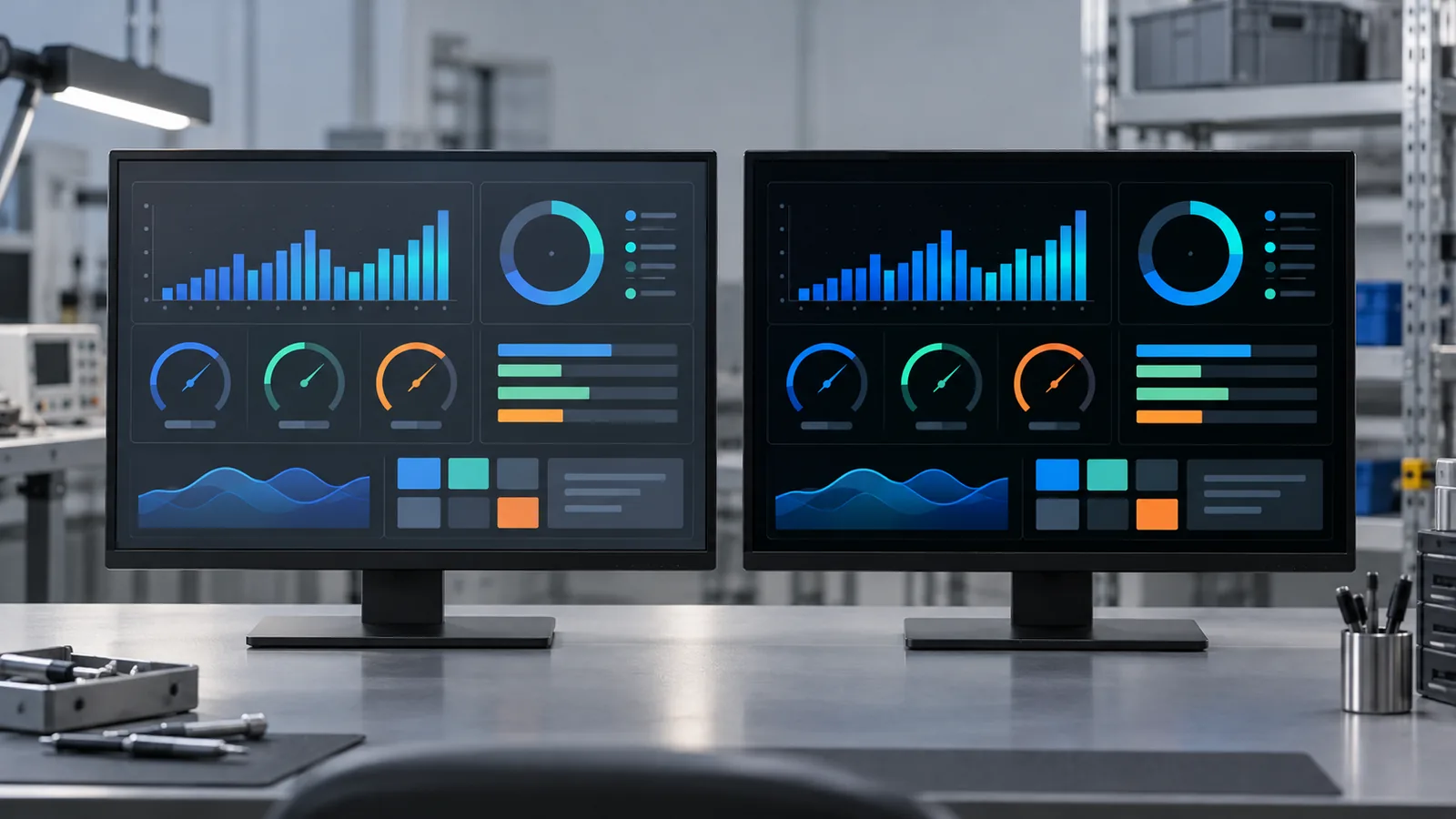
“LCD or OLED?” is usually answered by contrast and thickness in consumer products. In industrial equipment, other questions decide it: how bright the screen must be in the worst light, how long it shows the same layout, how hot the enclosure gets and how long the part must stay available. This guide compares the two technologies on those points and ends with a sample test plan.
TFTWorks supplies TFT LCD modules, so this is not an argument that one technology always wins. It is a way to decide which one deserves a sample in your product. For the general module checklist, start with the seven-specification industrial TFT LCD guide.
TFT LCD vs OLED at a glance
| Factor | TFT LCD | OLED | What to check |
|---|---|---|---|
| Light source | LED backlight behind a liquid-crystal layer | Each pixel emits its own light | Backlight driver (TFT) or panel driver and drive current (OLED) |
| Black level and contrast | Backlight leakage limits blacks in a dark room | Pixels can switch off, giving deep blacks and high contrast | Test in the darkest light your product sees |
| Peak brightness in sunlight | Raised through backlight design, current and optical films | Depends on content, temperature and lifetime target | Full-screen luminance at the temperature that matters |
| Burn-in and image retention | Usually lower risk | Static bright elements can age faster than their surroundings | Your UI's static elements and on-time |
| Lifetime driver | Mainly LED backlight luminance decay | Organic-material aging, brightness and duty cycle | End-of-life criterion, starting luminance, temperature |
| Power | Mostly backlight; changes little with content | Follows the share of lit pixels; low for dark UIs | Power measured with your real screens |
| Viewing angle | IPS is wide; TN is narrower | Generally wide | Mounting angle and viewers; see the IPS vs TN guide |
| Size and interface range | Wide size coverage; RGB, LVDS, MIPI DSI and MCU interfaces | Often most available in small sizes; confirm panel supply and driver IC | Host output, size, long-term availability |
| Touch and front stack | PCAP, cover glass and bonding are common | PCAP and cover glass are possible | Luminance and reflections after the full stack |
Brightness and sunlight readability
Sunlight readability is a system result: luminance, reflection control, the front stack and heat all contribute. On a TFT LCD, brightness comes from the backlight. Published TFTWorks modules list luminance from 320 cd/m² to 1200 cd/m² depending on the model, for example DS-T080QGH-09 at 1200 cd/m² and DS-T101HIEWA-01CP with bonded PCAP at 850 cd/m². These are module specifications, not measurements through a finished cover and enclosure.
OLED brightness is produced by the pixels themselves, so the figure you can rely on may depend on how much of the screen is lit, on temperature and on the lifetime target. When you compare, ask for full-screen luminance at the temperature that matters rather than a peak or small-window number. A high peak figure alone does not make an OLED sunlight readable, and a high nit figure alone does not do that for a TFT LCD either.
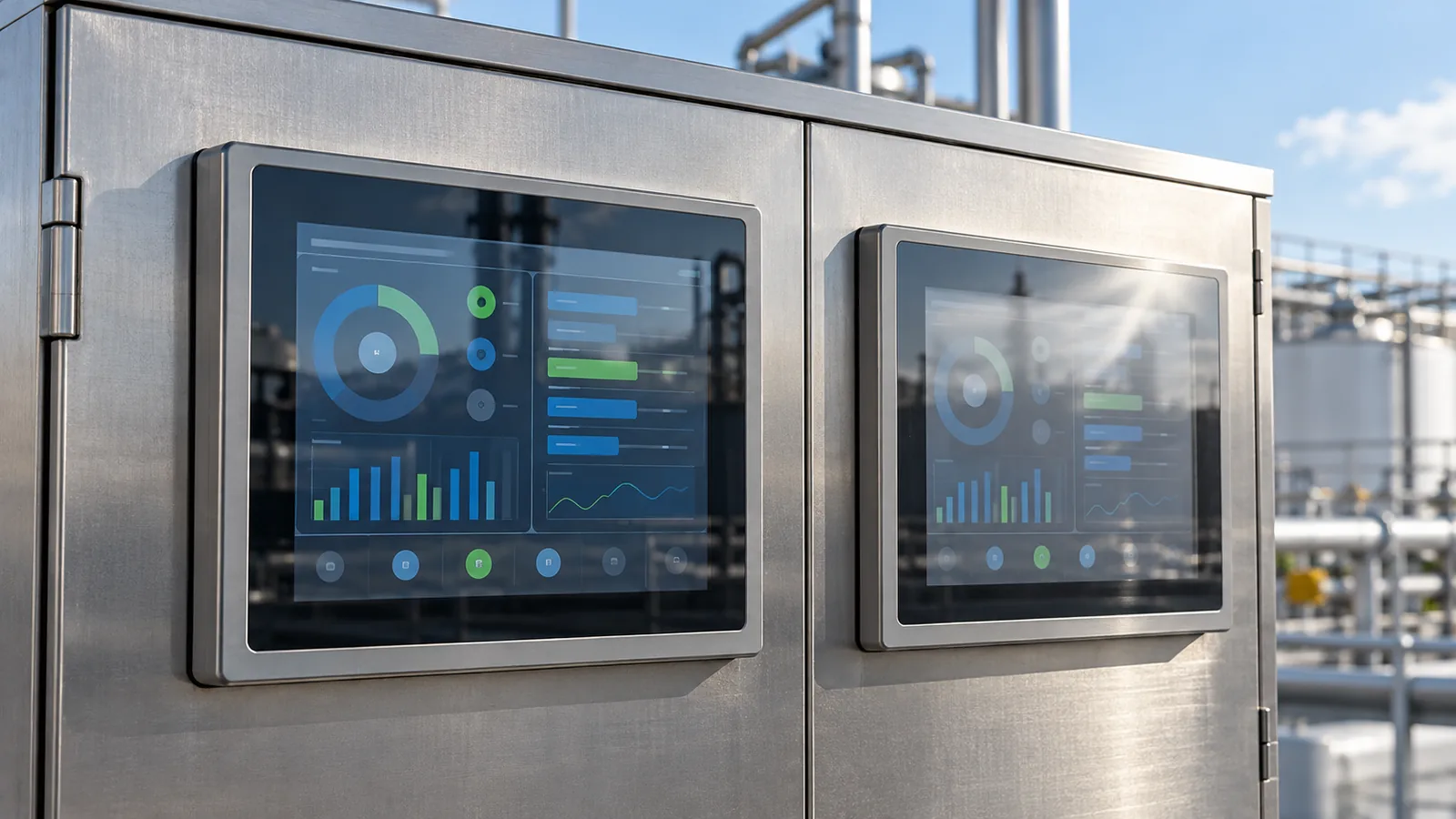
Reflection control matters for both technologies. See anti-glare vs anti-reflective vs optical bonding, what makes a TFT LCD sunlight readable and the 800 vs 1000 vs 1200 nit guide. For outdoor-facing products, also browse the sunlight-readable TFT modules.
Burn-in and static content
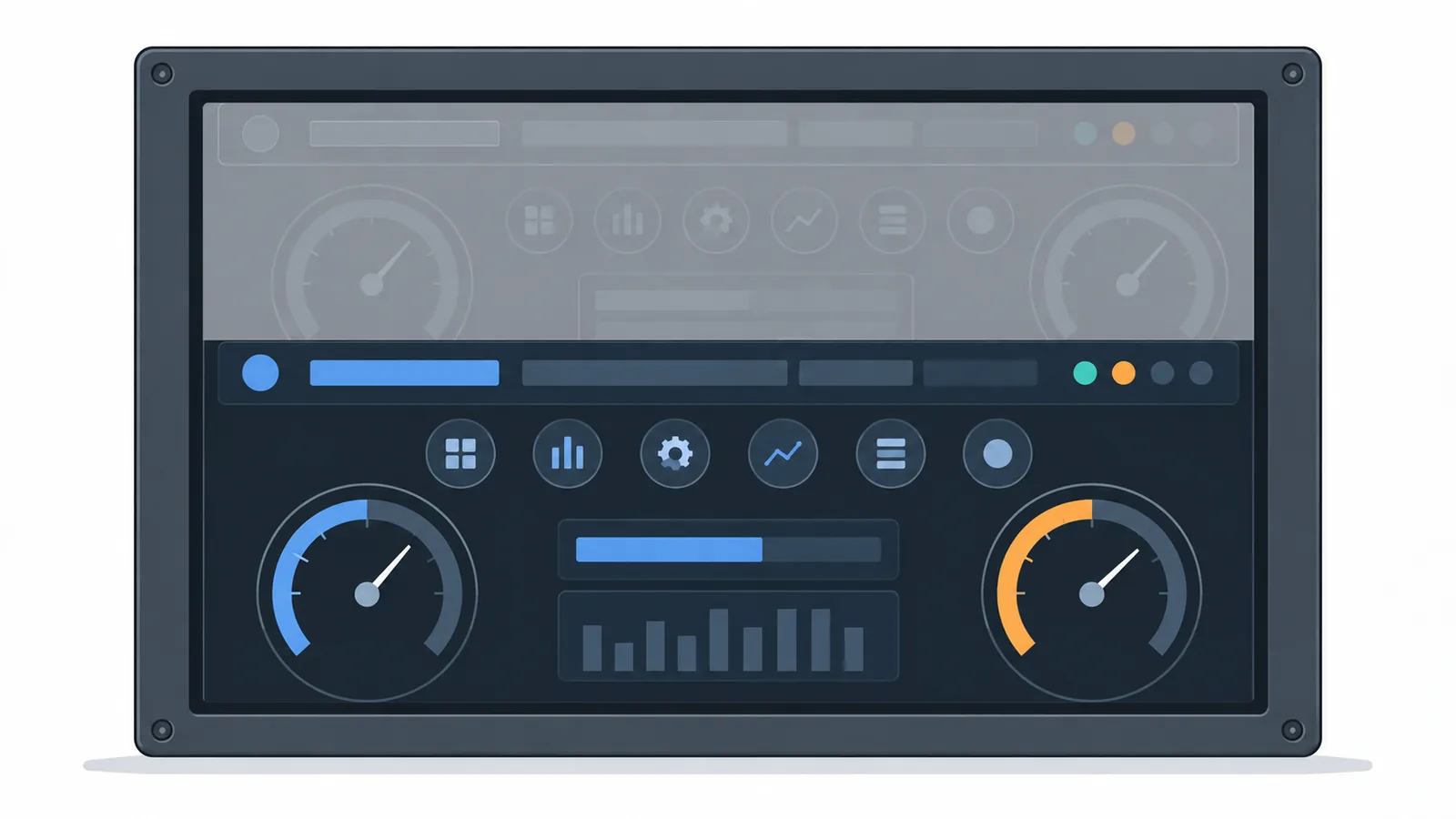
OLED burn-in is permanent image retention caused by uneven aging: pixels that show a bright element every day age faster than the pixels around them. Industrial interfaces are a demanding case because they often keep the same header, status icons, gauges and buttons on screen for many hours. A TFT LCD can show temporary image retention, but it is usually the lower risk for long static content.
| Content pattern | OLED consideration | TFT LCD consideration |
|---|---|---|
| Same header, icons and gauges for many hours a day | Highest burn-in attention. Plan pixel shifting, dimming or moving elements and test the result | Lower image-retention risk; confirm on a sample |
| Mostly dark UI with a few bright elements | Low average power, but the bright elements still age faster than the dark surroundings | Backlight stays on; black level is limited by backlight leakage |
| Light or white background | Higher power and aging across the whole area; check luminance and heat | Typical LCD use; power is mostly set by the backlight |
| Screen turns off between uses | Helps; define the timer and the wake behavior | Helps backlight life; define the dimming and wake behavior |
Lifetime: compare definitions, not hours
An hour figure means little until you know what “end of life” means. For a TFT LCD, lifetime is usually the time for the LED backlight to fall to a stated fraction of its initial luminance, such as L70 or L50, under stated temperature and current. For an OLED, lifetime depends on the organic materials, the brightness level and the duty cycle. Compare four things before you compare hours:
- The end-of-life criterion (for example 70% or 50% of initial luminance).
- The starting luminance the number was measured at.
- The temperature and drive conditions of the test.
- The content pattern, especially for OLED.
Then turn hours into calendar time. Example, not a claim for any product: 50,000 hours is about 5.7 years at 24-hour operation (50,000 ÷ 8,760). The industrial TFT LCD backlight lifetime guide shows how to ask a supplier for the conditions behind a lifetime claim.
Temperature and the enclosure
Both technologies need the temperature range checked in the finished product, not only on the datasheet. For a TFT LCD, low temperature can slow liquid-crystal response, and high temperature affects backlight life and the polarizer. For an OLED, high temperature can accelerate material aging, and low-temperature startup and brightness must be confirmed. Published TFTWorks modules list operating ranges such as −20 to +70 °C and −30 to +80 °C depending on the model; the right range for you is the one measured inside your enclosure, including sun load.
See the wide-temperature selection guide and brightness, heat and reliability in high-brightness TFT LCDs. You can also browse wide-temperature TFT modules.
Power consumption
A TFT LCD's power is mostly the backlight, so it changes little with what is on screen. An OLED's power follows the share of lit pixels: a dark interface can use little, while a large white area can bring an OLED close to, or above, a similar-size TFT LCD. Compare power using your real screens at the brightness the product runs at, then add the thermal effect to the enclosure budget. A battery product with a dark UI and a screen that sleeps is a different case from a mains-powered panel with a bright, always-on layout.
Interfaces, drivers and long-term supply
The display you choose has to match the host and stay available. Review these items for both technologies:
- Interface family. TFT LCD modules commonly use RGB, LVDS, MIPI DSI or MCU interfaces; see the TFT LCD interface guide. For an OLED, confirm the exact interface, driver IC and initialization sequence for the module you plan to use.
- Size coverage. The published TFTWorks range runs from 3.5 to 12.1 inches; browse it by size or interface. For an OLED, confirm that the size and resolution you need exist as a standard part.
- Availability and change control. Ask how end-of-life would be communicated and how a replacement would be handled; minimum order quantity and lead time vary by model and are not fixed commitments. The obsolete LCD replacement workflow lists the checks if a part changes.
Which one to sample first
Lean toward OLED when
- The interface is mostly dark and the screen sleeps or changes often.
- Contrast, black level or a very wide viewing angle drives the design.
- The size is small and a standard OLED part exists with a supply plan you accept.
- The ambient light and enclosure temperature are moderate.
Lean toward TFT LCD when
- The screen sits in bright light or behind a reflective front stack.
- The same layout stays on screen for many hours, day after day.
- The enclosure runs hot, or cold starts matter and need verification on both technologies.
- You need a wide range of sizes and interfaces, or long supply planning.
Sample both when
- The case is close, and the cost of a wrong choice is high.
- The UI could be redesigned to reduce static elements if OLED wins on other grounds.
A sample test plan
- Use your real screens. Test with the actual UI, including static elements, small text and status colors.
- Measure luminance and contrast in the finished front stack, in the darkest and brightest light the product sees.
- Run a long static-content test at the working brightness, then look for retention with a flat gray and a flat black screen.
- Check temperature behavior. Test cold start and hot soak inside the enclosure, with the backlight or panel at working brightness.
- Measure power with your real screens and brightness settings.
- Confirm the host path. Verify interface, timing and initialization against the exact model and revision.
- Record everything with photos, settings and sample revision.
The sample validation checklist and the requirements checklist turn these steps into documents you can send with an enquiry.
TFT LCD vs OLED FAQ
Is OLED better than TFT LCD for industrial displays?
Not in general. OLED has real advantages in contrast, black level and viewing angle, and it can suit dark user interfaces. TFT LCD is often the lower-risk choice for bright ambient light, long periods of static content, wide size and interface coverage, and long supply planning. The right answer depends on the content, the environment and the supply requirements, verified on samples.
Is OLED burn-in a problem for an industrial HMI?
It can be, when the same bright elements such as a header, icons or gauges stay on screen for many hours a day. The risk depends on brightness, duty cycle and content, and it can be reduced with pixel shifting, dimming or screen-off timers. If the layout is static around the clock, test it on samples or consider a TFT LCD, which usually carries a lower image-retention risk.
Can an OLED display be used outdoors?
It can be evaluated, but a high peak luminance figure alone does not make a display sunlight readable. Ask for full-screen luminance at the temperature that matters, then judge the finished front stack, reflections and thermal behavior in the real enclosure and light.
Which lasts longer, TFT LCD or OLED?
Hour figures are not comparable until the definitions match. For a TFT LCD the figure usually describes backlight luminance decay; for an OLED it depends on the organic materials, brightness and duty cycle. Compare the end-of-life criterion, the starting luminance, the temperature and the content pattern before comparing hours.
Technical references
- Newhaven Display — OLED vs LCD: manufacturer overview of technology selection, viewing conditions and content patterns.
- Newhaven Display — How to Avoid Image Burn-in: manufacturer guidance on image retention, static content and mitigation. Confirm the exact panel and operating conditions.
Send Us Your UI Screens and Operating Conditions
Share the display size, host interface, brightness target, temperature range and the screens your product shows for the longest time. TFTWorks can review published TFT LCD modules or a customization path against the exact configuration.
Request a Project Review Browse industrial TFT modules
How to send drawings or UI screenshots
The project-review form accepts text details, not file uploads. Send your initial requirements there, or attach your files directly by email or WhatsApp. Include the reference model, your company and the project context so the files can be matched to your enquiry. Do not send confidential files without agreeing the sharing terms.
Continue the engineering review
Publisher and scope. Published by TFTWorks, operated by Guangdong Dexing Microelectronics Co., Ltd. TFTWorks supplies TFT LCD modules. Technology comparisons here are general tendencies that vary by model, so confirm them against the current model-specific datasheet and validate samples in your own product.