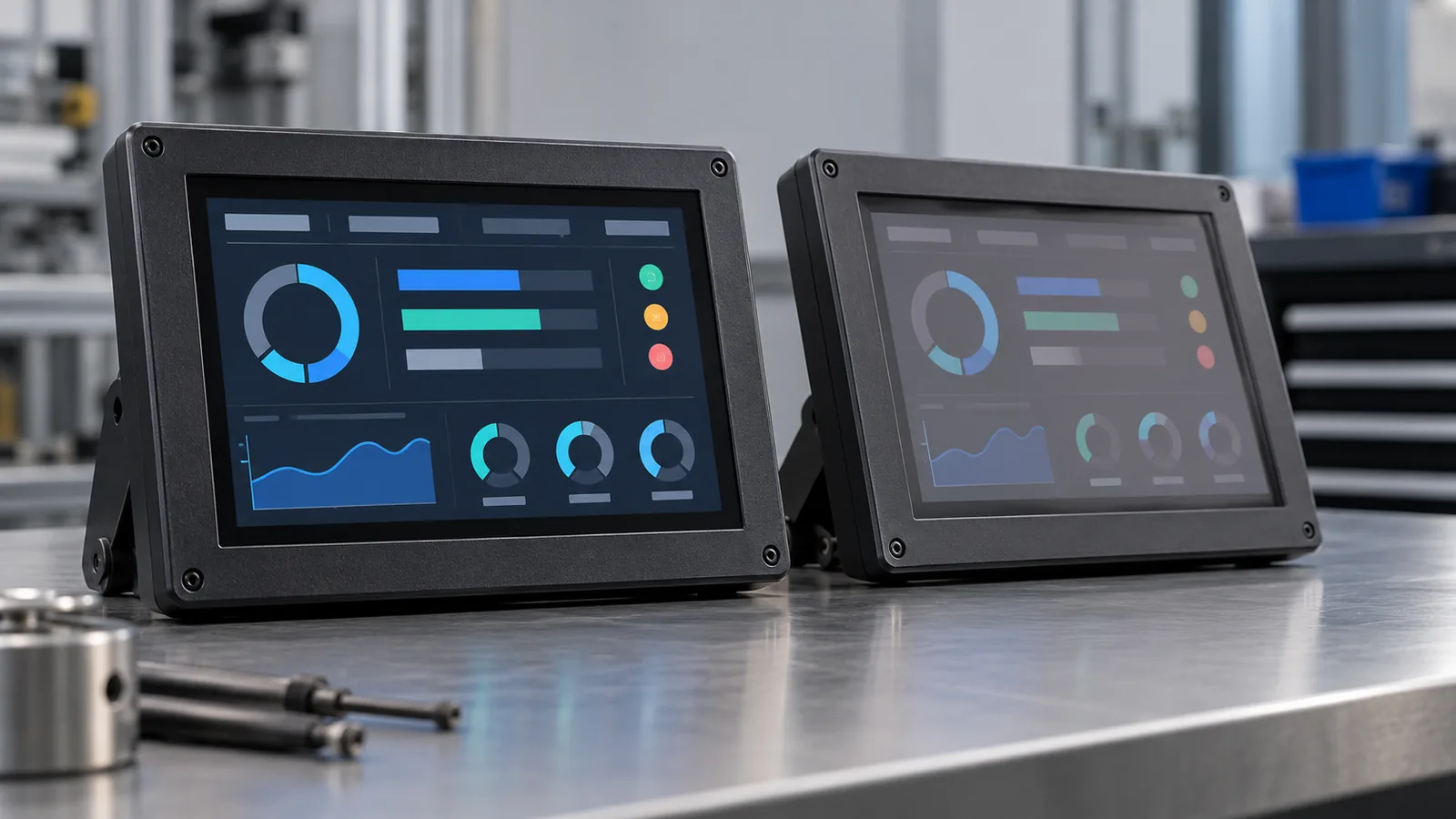
“IPS or TN?” is one of the first questions on a display shortlist, and it is often answered from habit. This guide gives a practical way to decide: compare what each technology does well, test it at the real viewing geometry, and weigh it with brightness, heat, cost and the rest of the front stack. For the wider selection checklist, see the seven-specification industrial TFT LCD guide.
IPS vs TN at a glance
| Factor | IPS | TN | What to check |
|---|---|---|---|
| Off-axis image | Wide viewing angle with relatively small color and contrast shift | Narrower; shift and gray-level inversion appear mainly in one vertical direction | Test at the real mounting angle |
| On-axis image | Good color consistency | Can show strong on-axis brightness and contrast | Compare measured values that use the same definition |
| Luminance efficiency | Often lower light transmission, so more backlight power may be needed for the same luminance | Often higher light transmission, so a given luminance may need less backlight power | Backlight power and heat at the target nits |
| Dark UI at an angle | Dark areas can lose depth at wide angles | Dark and light tones can invert in the weak direction | Test your real dark-theme screens |
| Panel cost | Often higher at the same size and resolution | Often lower | Compare total assembly cost, not panel price alone |
| Typical fit | Shared or multi-position viewing, portrait use, color-critical UI | Fixed viewing direction, simple UI, cost or luminance-per-watt focus | Operator position and UI content |
Viewing angle in practice
A viewing-angle number on a datasheet rarely tells the whole story. TN datasheets usually state a preferred viewing direction, often described by a clock position such as 6 o'clock or 12 o'clock. Outside that direction, gray-scale inversion can appear: dark tones look lighter and light tones look darker. IPS panels are designed to keep contrast and color more consistent across directions, although they are not perfect at extreme angles.
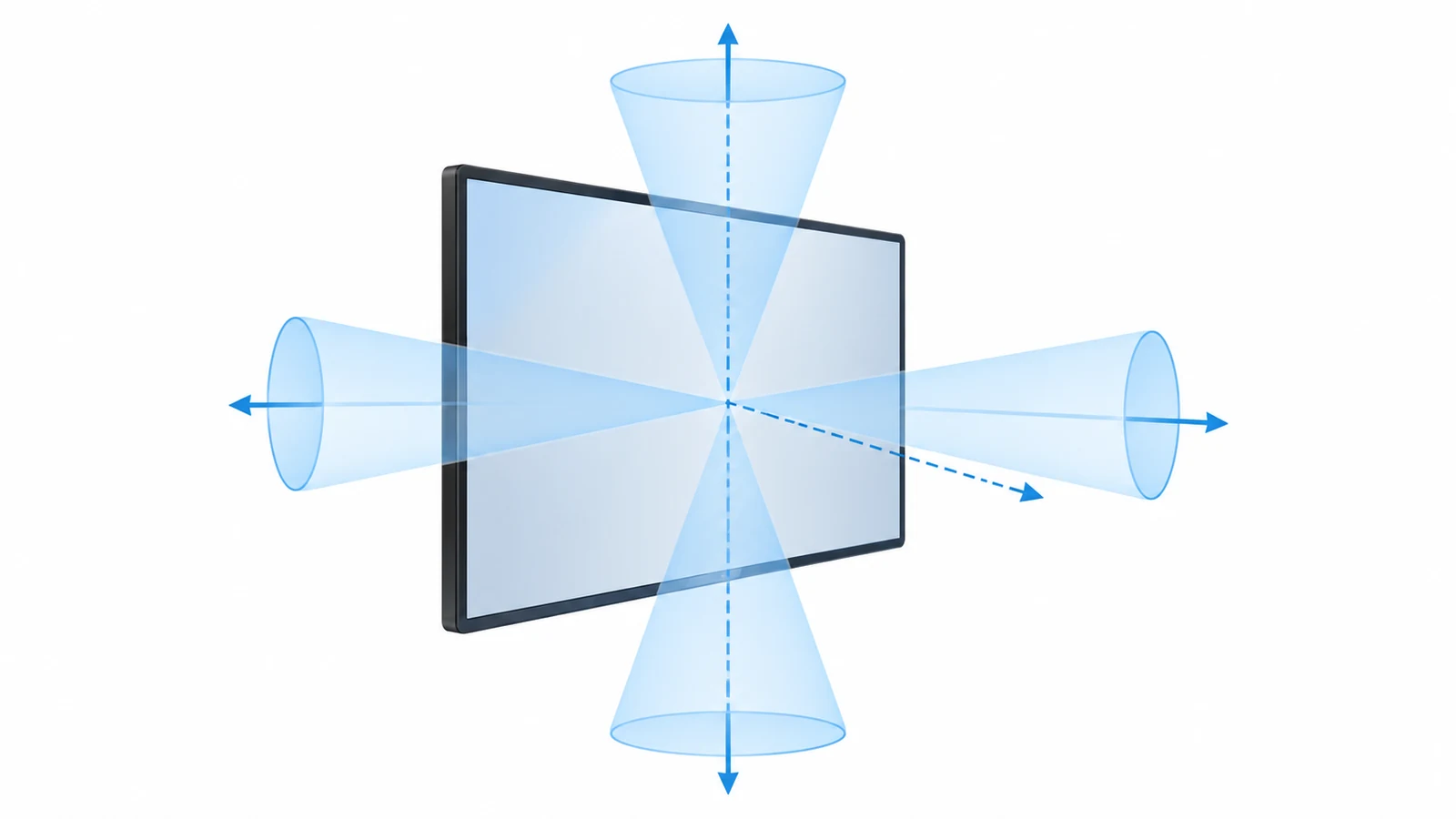
Mounting geometry is the key input. Ask these questions before choosing:
- Are the operator's eyes above, level with or below the panel center?
- Is the panel tilted, and can the tilt change between installations?
- Will more than one person read the same screen at the same time?
- Will the product ever be used in portrait as well as landscape? Rotating a panel changes which of its viewing directions is the weak one.
The last point matters for narrow or vertical layouts such as bar-type TFT LCDs, where the orientation is part of the design.
Brightness, power and heat
Light transmission and luminance target are linked. A panel that passes more light can reach a target luminance with less LED power, which helps heat and supply planning. Higher pixel density can also reduce light transmission for either panel type, so resolution belongs in the same discussion.
A quick look at published TFTWorks modules shows why the panel type should be reviewed together with the nit target: the 8-inch 800×600 DS-T080QGH-09 is listed as TN at 1200 cd/m², while the 8-inch 1024×768 DS-T080BXEA-05 is listed as IPS at 950 cd/m². These modules differ in resolution, interface and backlight design, so the pair is not a like-for-like proof that TN reaches higher luminance; it simply shows how many variables sit behind one nit number.
Before fixing a luminance target, read the 800 vs 1000 vs 1200 nit guide, the high-brightness thermal trade-offs and the backlight lifetime guide. Heat at the intended luminance can matter more than the datasheet's maximum.
Outdoor use and polarized eyewear
Sunlight readability depends on luminance, reflection control and the front stack, and panel type is only one input. Polarized sunglasses add a practical wrinkle: an LCD emits polarized light, so the screen can dim or change color depending on the angle between the display's polarizer and the lens. The effect depends on the panel, the films in the front stack and whether the equipment is used in landscape or portrait.
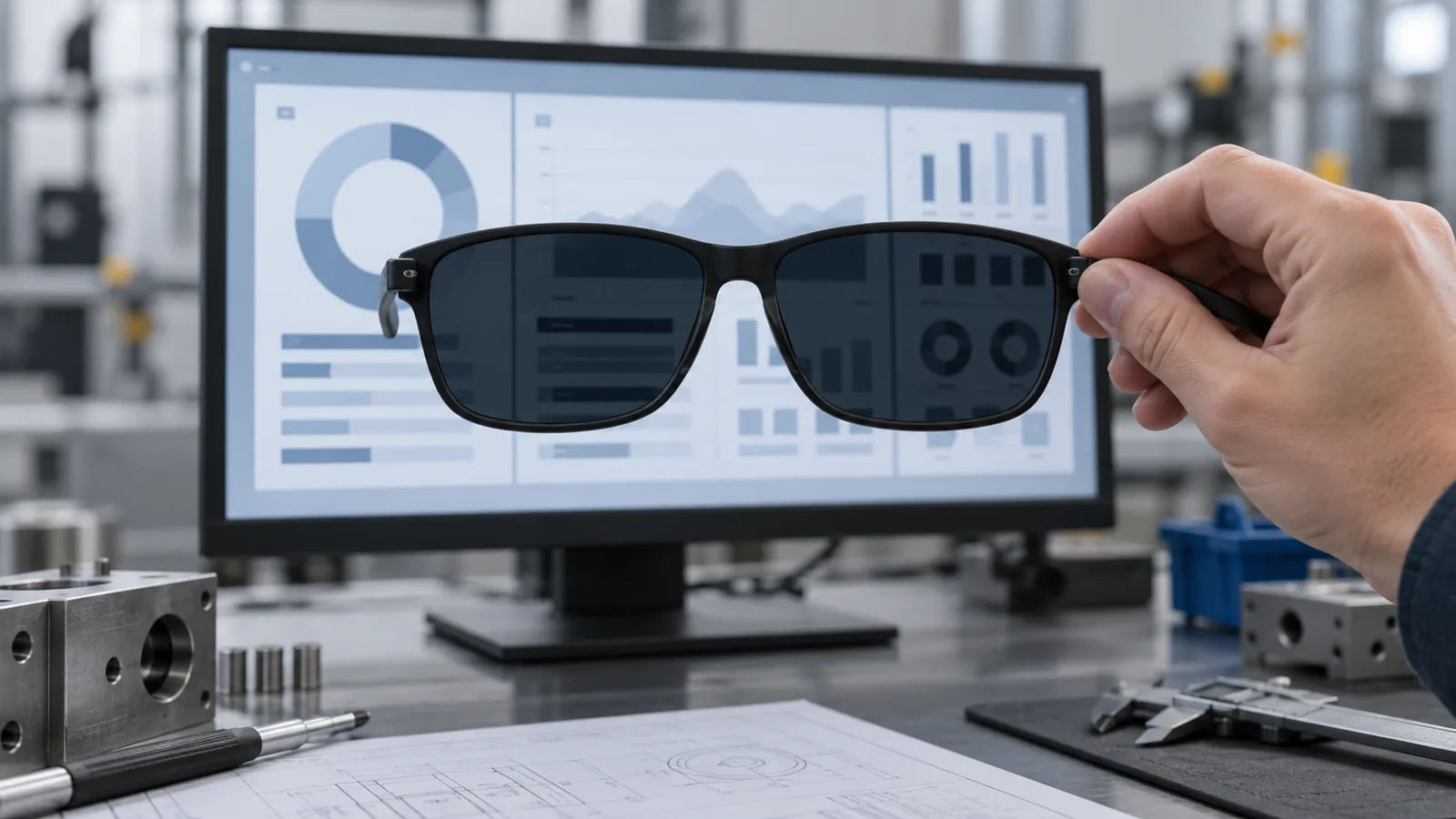
If operators wear polarized eyewear outdoors, test with that eyewear at the real orientation instead of assuming either panel type is immune. The sunlight-readable TFT LCD guide explains how brightness, reflection control and bonding work together.
Touch, bonding and the front stack
IPS and TN modules can both be combined with PCAP touch and optical bonding, so the front-stack decision is largely independent of the panel type. What changes is the evaluation: optical bonding removes an internal air gap and changes how reflections and contrast look, so judge the finished stack rather than the bare module. See anti-glare vs anti-reflective vs optical bonding, optical bonding for industrial TFT LCDs and the industrial PCAP touchscreen design guide.
Cost and total assembly
TN is often less expensive at the panel level, particularly in some size and resolution classes. A lower panel price does not always mean a lower system cost, though. Add the backlight and driver, thermal design, cover glass, touch and bonding, test effort and the cost of a field complaint about readability. In many size and resolution classes the practical choice is also narrowed by the host interface, mechanical outline and availability, so start with the modules that meet those needs and then compare panel types among them.
Published TFTWorks examples
The table lists a few modules from the industrial TFT range. Values are shortlist references; confirm the current datasheet, drawing and pinout for the exact model before design-in.
| Model | Size / resolution | Panel type | Luminance | Interface |
|---|---|---|---|---|
| DS-T080QGH-09 | 8.0 in, 800×600 | TN | 1200 cd/m² | RGB 24-bit, 50-pin |
| DS-T080BXEA-05 | 8.0 in, 1024×768 | IPS | 950 cd/m² | LVDS 6/8-bit, 40-pin |
| DS-T043BWSA-02 | 4.3 in, 800×480 | IPS | 900 cd/m² | RGB 24-bit, 40-pin |
| DS-T101HIEWA-01 | 10.1 in, 1280×800 | IPS | 1000 cd/m² | LVDS 6/8-bit, 40-pin |
Most of the published range is IPS, with the TN 8-inch module as a distinct option for the bright 4:3 HMI review. For brightness- or temperature-led shortlists, start with high-brightness or wide-temperature modules. For cold environments, also read the wide-temperature selection guide; response and contrast change with temperature for any panel type.
A sample test protocol
Do not settle IPS vs TN from a datasheet alone. A short, repeatable test avoids most surprises:
- Mount at the real angle. Fix the sample in the enclosure or a jig that reproduces the intended tilt and height.
- Use your own screens. Show the actual UI, including dark themes, small text, thin lines and status colors.
- Add reference patterns. Use a gray ramp, color bars and a flat dark field to expose inversion and glow.
- Check from the user positions. Photograph or measure from each position with the same camera settings.
- Test eyewear. Repeat the key views through polarized eyewear in landscape and, if relevant, portrait.
- Run temperature and brightness conditions. Check readability and response at the extremes and at the final brightness setting.
- Record the result. Keep photos, settings and sample revision so the choice can be reproduced.
The sample validation checklist expands this into bench and in-product validation.
Choosing between them
Lean toward IPS when
- More than one person reads the display, or the viewing position varies.
- The panel is mounted below or above eye level, or can be used in portrait and landscape.
- Color or contrast consistency affects how the UI is read.
- The shortlist already contains IPS modules that meet the host and interface needs.
Review TN when
- The viewing direction is fixed and the preferred direction can be matched to the mounting angle.
- The UI is simple and tolerant of tonal shifts.
- Luminance per watt or panel cost is a primary constraint, and a sample passes your tests.
If you are replacing an existing display, do not compare the diagonal alone; follow the obsolete industrial TFT LCD replacement workflow.
IPS vs TN FAQ
Is IPS always better than TN for industrial displays?
No. IPS is the safer default when the display is read from several positions or when image consistency matters. TN can be a reasonable choice when the viewing direction is fixed and known, the UI is simple and cost or luminance efficiency matters more. The mounting angle and the real UI should decide, verified on samples.
Does an IPS display always cost more than a TN display?
At the panel level IPS is often priced higher at the same size and resolution, but the difference varies by size, volume and model. Compare total assembly cost, including backlight power, thermal design, cover glass and bonding, rather than panel price alone.
Can I replace a TN module with an IPS module of the same size?
Not on size alone. Compare the mechanical outline, FPC and connector, pinout, timing, power and backlight requirements, then validate samples in the product.
Does IPS improve sunlight readability?
Not by itself. Outdoor readability depends on luminance, reflection control, the front stack and thermal design. IPS helps with off-axis consistency, which is a separate question from sunlight readability.
Technical references
- Newhaven Display — What is an IPS Display?: manufacturer overview of viewing-angle behavior and panel trade-offs. General technology comparisons do not establish the power, color accuracy or compatibility of a TFTWorks module; verify the exact configuration.
Send Us Your Mounting Angle and UI Screens
Tell us the display size, host interface, brightness target, mounting geometry and operating environment. TFTWorks can review IPS and TN options against the exact configuration instead of a generic panel label.
Publisher and scope. Published by TFTWorks, operated by Guangdong Dexing Microelectronics Co., Ltd. Panel-type tendencies are general engineering guidance and vary by model. Confirm viewing angle, luminance, contrast and temperature behavior against the current model-specific datasheet and validate samples in your own product.